Bias-Aware Early Warning System for Higher Education

Final Summary Report

Published

January 4, 2026

Modified

January 9, 2026

Executive Summary

This research project developed and evaluated a bias-aware Early Warning System (EWS) to identify at-risk students in higher education while addressing algorithmic fairness concerns. Using the Open University Learning Analytics Dataset (OULAD), we built an LSTM-based temporal prediction model and systematically audited and mitigated algorithmic bias.

Key Results

Objective Target Achieved
Predictive Performance AUC > 0.80 0.889
Early Prediction First 25% of course 10 weeks (~26% of 33–38 week courses)
Bias Mitigation Reduce disparities All four attributes improved
Intersectional Fairness No critical issues Validated across 16 subgroups

What We Did

  1. Built an early prediction model using a dual-branch LSTM architecture that combines 10 weeks of VLE engagement patterns with static demographic features, enabling intervention while 75% of the course remains

  2. Audited fairness across five protected attributes using four metrics (SPD, EOD, Equalized Odds, ABROCA), finding significant disparities for region (4/4 violations), IMD band, disability, and age

  3. Mitigated bias using attribute-appropriate techniques: threshold optimization for large groups (region, IMD, age) and reweighting for underrepresented groups (disability), reducing Equal Opportunity Difference to near-zero while maintaining AUC

  4. Validated intersectional fairness across 16 demographic subgroups, confirming no severe compounding disparities and AUC > 0.80 for all intersections

Key Findings

  • Regional bias was most severe: Students in Scotland, Wales, and London were flagged at higher rates than equally at-risk students in Ireland and Southern England
  • Mitigation approach matters: Post-processing (threshold optimization) works for well-represented groups; pre-processing (reweighting) is needed for minorities like students with disabilities (9% of data)
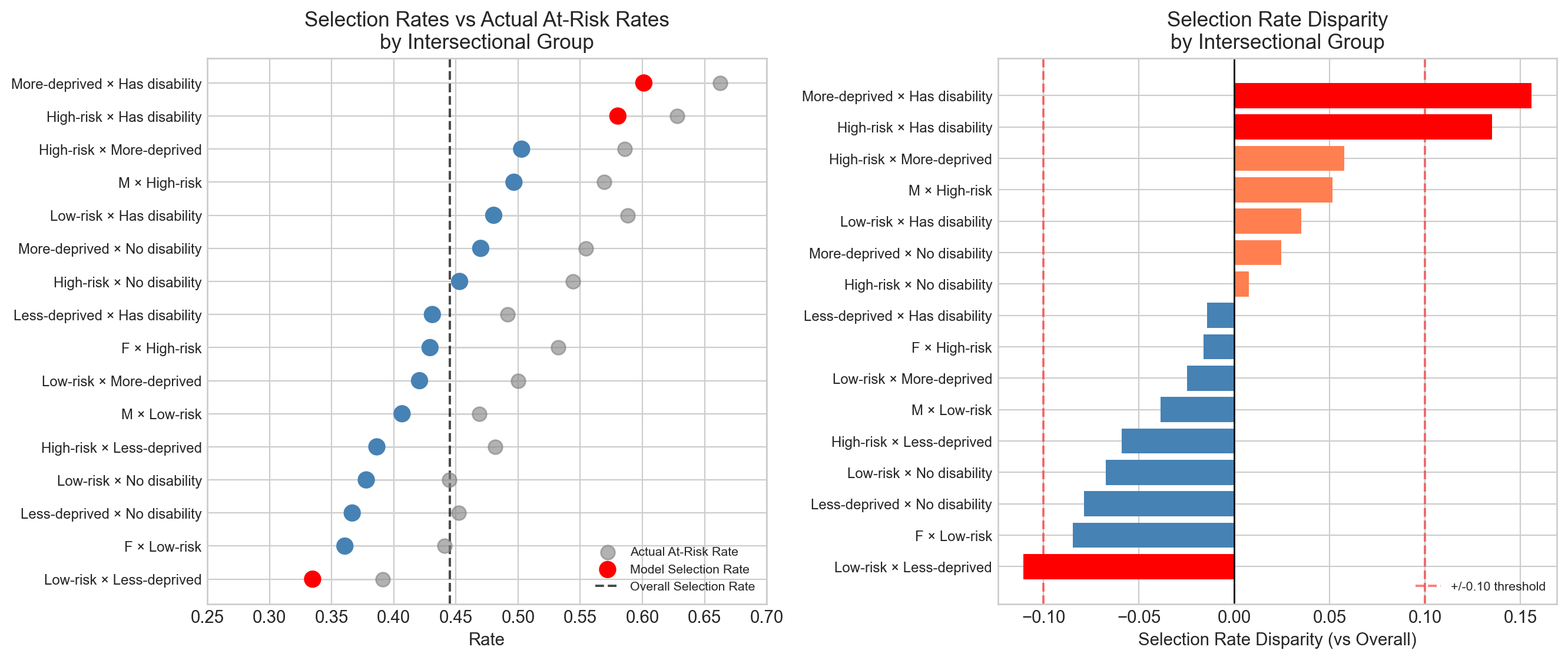
  • Selection rate disparities reflect real risk differences: The 0.266 range in intersectional selection rates mirror the underlying at-risk rate variation, not model discrimination

Limitations Acknowledged

This analysis is bounded by OULAD’s specific context (UK distance learning, 2013–2014 data), the 10-week prediction window trade-off, and unmeasured factors (employment, health, family circumstances) that influence student outcomes. The model should supplement—not replace—human judgment in student support decisions.

Code
import os
import warnings
import numpy as np
import pandas as pd
import json
from pathlib import Path
import matplotlib.pyplot as plt
import seaborn as sns

os.environ['TF_CPP_MIN_LOG_LEVEL'] = '2'
warnings.filterwarnings('ignore')

plt.style.use('seaborn-v0_8-whitegrid')
plt.rcParams['figure.figsize'] = (12, 6)
plt.rcParams['font.size'] = 11

DATA_DIR = Path("data/processed")
FIGURES_DIR = Path("figures")
FIGURES_DIR.mkdir(exist_ok=True)

# Load all results
with open(DATA_DIR / 'fairness_results.json', 'r') as f:
    fairness_results = json.load(f)

with open(DATA_DIR / 'mitigation_results_region.json', 'r') as f:
    mitigation_region = json.load(f)

with open(DATA_DIR / 'mitigation_results_imd.json', 'r') as f:
    mitigation_imd = json.load(f)

with open(DATA_DIR / 'mitigation_results_disability.json', 'r') as f:
    mitigation_disability = json.load(f)

with open(DATA_DIR / 'mitigation_results_age.json', 'r') as f:
    mitigation_age = json.load(f)

with open(DATA_DIR / 'intersectional_results.json', 'r') as f:
    intersectional_results = json.load(f)

predictions = pd.read_csv(DATA_DIR / 'predictions_baseline.csv')
static_df = pd.read_csv(DATA_DIR / 'features_static.csv')

Research Questions

This project addressed the following research questions:

  1. RQ1: How do socioeconomic, geographic, and demographic characteristics predict at-risk students in higher education?

  2. RQ2: What is the extent of algorithmic bias across protected attributes (gender, region, relative poverty, age, disability) in temporal EWS models?

  3. RQ3: What is the effectiveness of different bias mitigation approaches (pre-processing, post-processing) in reducing prediction disparities while maintaining strong predictive performance (AUC ROC > 0.80)?

Dataset Overview

The Open University Learning Analytics Dataset (OULAD) contains data from 32,593 student enrollments across 22 course presentations.

Code
from IPython.display import display, Markdown

# 1. Calculate values
total_students = len(static_df)
unique_courses = static_df['code_module'].nunique()
presentations = (static_df['code_module'] + '_' + static_df['code_presentation']).nunique()

at_risk = static_df['at_risk'].sum()
at_risk_pct = static_df['at_risk'].mean() * 100
not_at_risk = (1 - static_df['at_risk']).sum()
not_at_risk_pct = (1 - static_df['at_risk'].mean()) * 100

# 2. Build the string with explicit newlines
report_text = f"""
**Dataset Statistics:**

* **Total student enrollments:** {total_students:,}
* **Unique courses:** {unique_courses}
* **Course presentations:** {presentations}

**Target Variable (At-Risk):**

* **At-risk (1):** {at_risk:,} ({at_risk_pct:.1f}%)
* **Not at-risk (0):** {not_at_risk:,} ({not_at_risk_pct:.1f}%)

**Protected Attributes:**

"""

# 3. Loop to add bullet points
for attr in ['gender', 'region', 'imd_band_imputed', 'age_band', 'disability']:
    if attr in static_df.columns:
        count = static_df[attr].nunique()
        clean_name = attr.replace('_', ' ').title().replace('Imd', 'IMD')
        # Add the bullet point with a newline at the end
        report_text += f"* **{clean_name}:** {count} groups\n"

display(Markdown(report_text))

Dataset Statistics:

  • Total student enrollments: 32,593
  • Unique courses: 7
  • Course presentations: 22

Target Variable (At-Risk):

  • At-risk (1): 17,208 (52.8%)
  • Not at-risk (0): 15,385 (47.2%)

Protected Attributes:

  • Gender: 2 groups
  • Region: 13 groups
  • IMD Band Imputed: 10 groups
  • Age Band: 3 groups
  • Disability: 2 groups
Code
fig, axes = plt.subplots(2, 3, figsize=(15, 10))

# Gender
ax = axes[0, 0]
gender_rates = static_df.groupby('gender')['at_risk'].mean().sort_values(ascending=False)
bars = ax.bar(gender_rates.index, gender_rates.values, color=['steelblue', 'coral'])
ax.set_ylabel('At-Risk Rate')
ax.set_title('At-Risk Rate by Gender')
ax.set_ylim(0, 0.7)
for bar in bars:
    ax.text(bar.get_x() + bar.get_width()/2, bar.get_height() + 0.01,
            f'{bar.get_height():.1%}', ha='center', fontsize=10)

# Age
ax = axes[0, 1]
age_rates = static_df.groupby('age_band')['at_risk'].mean().sort_values(ascending=False)
bars = ax.bar(age_rates.index, age_rates.values, color='steelblue')
ax.set_ylabel('At-Risk Rate')
ax.set_title('At-Risk Rate by Age Band')
ax.set_ylim(0, 0.7)

# Disability
ax = axes[0, 2]
disability_rates = static_df.groupby('disability')['at_risk'].mean().sort_values(ascending=False)
disability_rates.index = ['Has Disability' if x == 'Y' else 'No Disability' for x in disability_rates.index]
bars = ax.bar(disability_rates.index, disability_rates.values, color=['coral', 'steelblue'])
ax.set_ylabel('At-Risk Rate')
ax.set_title('At-Risk Rate by Disability Status')
ax.set_ylim(0, 0.7)
for bar in bars:
    ax.text(bar.get_x() + bar.get_width()/2, bar.get_height() + 0.01,
            f'{bar.get_height():.1%}', ha='center', fontsize=10)

# Region
ax = axes[1, 0]
region_rates = static_df.groupby('region')['at_risk'].mean().sort_values(ascending=False)
colors = ['coral' if r >= 0.5 else 'steelblue' for r in region_rates.values]
bars = ax.barh(region_rates.index, region_rates.values, color=colors)
ax.set_xlabel('At-Risk Rate')
ax.set_title('At-Risk Rate by Region')
ax.axvline(x=0.5, color='red', linestyle='--', alpha=0.5)

# IMD Band
ax = axes[1, 1]
imd_order = ['0-10%', '10-20', '20-30%', '30-40%', '40-50%', '50-60%', '60-70%', '70-80%', '80-90%', '90-100%']
imd_rates = static_df.groupby('imd_band_imputed')['at_risk'].mean()
imd_rates = imd_rates.reindex([x for x in imd_order if x in imd_rates.index])
colors = ['coral' if r >= 0.5 else 'steelblue' for r in imd_rates.values]
bars = ax.bar(range(len(imd_rates)), imd_rates.values, color=colors)
ax.set_xticks(range(len(imd_rates)))
ax.set_xticklabels(imd_rates.index, rotation=45, ha='right')
ax.set_ylabel('At-Risk Rate')
ax.set_title('At-Risk Rate by IMD Band (Deprivation)')
ax.axhline(y=0.5, color='red', linestyle='--', alpha=0.5)

# Legend
ax = axes[1, 2]
ax.text(0.5, 0.7, 'IMD Band Interpretation:', fontsize=12, fontweight='bold',
        ha='center', transform=ax.transAxes)
ax.text(0.5, 0.55, '0-10% = Most deprived areas', fontsize=11, ha='center', transform=ax.transAxes)
ax.text(0.5, 0.45, '90-100% = Least deprived areas', fontsize=11, ha='center', transform=ax.transAxes)
ax.text(0.5, 0.25, 'Red bars indicate groups with', fontsize=11, ha='center', transform=ax.transAxes)
ax.text(0.5, 0.15, 'at-risk rate >= 50%', fontsize=11, ha='center', transform=ax.transAxes)
ax.axis('off')

plt.tight_layout()
plt.show()
Figure 1: At-risk rates across protected attributes

Model Architecture and Performance

Early Prediction Window

A key design decision was when to make predictions. We chose a 10-week observation window, representing approximately the first 25% of course completion:

Table 1: Prediction Window Design
Course Length 25% Window Our Window Coverage
234–269 days (33–38 weeks) 58–67 days (8–10 weeks) 70 days (10 weeks) ~26%

Rationale for 10 weeks:

  • Early enough for intervention: Students flagged in week 10 still have 75% of the course remaining to improve
  • Sufficient behavioral signal: 10 weeks captures meaningful Virtual Learning Environment (VLE) engagement patterns (login frequency, resource access, assessment attempts)
  • Practical alignment: Matches typical institutional early-alert review periods
  • Trade-off accepted: Earlier predictions (e.g., week 4) would have less data; later predictions reduce intervention time

We developed a dual-branch Long Short-Term Memory (LSTM) architecture that combines:

  • Temporal features: 10-week VLE engagement sequences (clicks, activity types)
  • Static features: Demographics, prior education, course registration timing

Architecture Diagram

flowchart TD
    subgraph Model [LSTM-Based EWS Model]
        direction TB
        
        %% Temporal Branch
        subgraph Temporal [Temporal Branch]
            direction TB
            InputTemp[Input: 10x5<br/>weeks x feat] --> LSTM[LSTM 64<br/>+ Dropout]
        end

        %% Static Branch
        subgraph Static [Static Branch]
            direction TB
            InputStat[Input: 14<br/>features] --> Dense1[Dense 32<br/>+ ReLU]
        end

        %% Connections to Concatenate
        LSTM --> Concat
        Dense1 --> Concat

        %% Merged Layers
        Concat[Concatenate<br/>96 units] --> Dense2[Dense 32<br/>+ Dropout]
        Dense2 --> Output[Dense 1<br/>+ Sigmoid]
    end
    
    %% Styling (Optional)
    style Model fill:#f9f9f9,stroke:#333,stroke-width:2px
    style Temporal fill:#e6f3ff,stroke:#333,stroke-dasharray: 5 5
    style Static fill:#fff0e6,stroke:#333,stroke-dasharray: 5 5
    style Concat fill:#eee,stroke:#333
    style Output fill:#d4edda,stroke:#333
Figure 2: Dual-branch LSTM-Based EWS Model Architecture

Training Configuration:

  • Data Split: 70% train | 15% validation | 15% test
  • Batch Size: 256
  • Optimizer: Adam (lr=0.001)
  • Early Stopping: patience=5 (validation AUC)
  • Random Seed: 42

Performance Metrics

Code
from sklearn.metrics import roc_curve, auc, precision_recall_curve, confusion_matrix

# 1. Get predictions
y_true = predictions['y_true'].values
y_prob = predictions['y_pred_proba'].values
y_pred = predictions['y_pred'].values

# 2. Calculate metrics
fpr, tpr, _ = roc_curve(y_true, y_prob)
roc_auc = auc(fpr, tpr)

precision, recall, _ = precision_recall_curve(y_true, y_prob)
pr_auc = auc(recall, precision)

cm = confusion_matrix(y_true, y_pred)
tn, fp, fn, tp = cm.ravel()

accuracy = (tp + tn) / (tp + tn + fp + fn)
precision_val = tp / (tp + fp)
recall_val = tp / (tp + fn)
f1 = 2 * precision_val * recall_val / (precision_val + recall_val)
specificity = tn / (tn + fp)

# 3. Construct Markdown Table
# We use f-strings to insert the calculated variables directly into the table rows.
markdown_table = f"""
| Metric | Value | Target |
|:-------|:-----:|:------:|
| **AUC-ROC** | {roc_auc:.4f} | >0.80 ✓ |
| **AUC-PR** | {pr_auc:.4f} | |
| **Accuracy** | {accuracy:.4f} | |
| **Precision** | {precision_val:.4f} | |
| **Recall (Sensitivity)** | {recall_val:.4f} | |
| **Specificity** | {specificity:.4f} | |
| **F1-Score** | {f1:.4f} | |
"""

display(Markdown(markdown_table))
Table 2: Model Performance
Metric Value Target
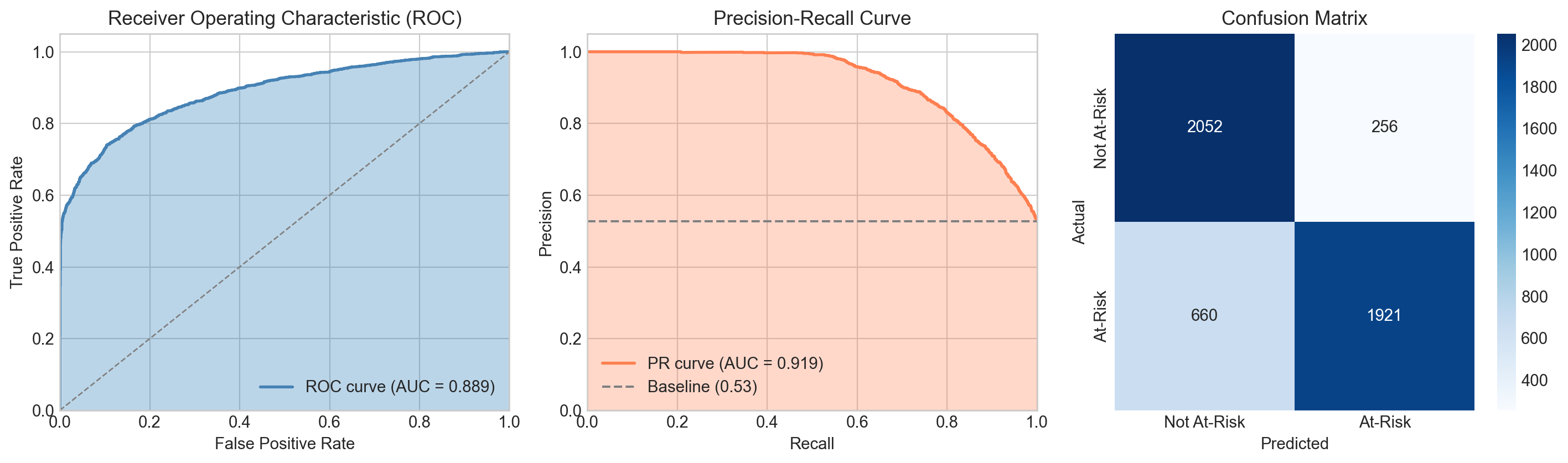
AUC-ROC 0.8889 >0.80 ✓
AUC-PR 0.9187
Accuracy 0.8126
Precision 0.8824
Recall (Sensitivity) 0.7443
Specificity 0.8891
F1-Score 0.8075
Code
fig, axes = plt.subplots(1, 3, figsize=(15, 4.5))

# ROC Curve
ax = axes[0]
ax.plot(fpr, tpr, color='steelblue', lw=2, label=f'ROC curve (AUC = {roc_auc:.3f})')
ax.plot([0, 1], [0, 1], color='gray', lw=1, linestyle='--')
ax.fill_between(fpr, tpr, alpha=0.3)
ax.set_xlim([0.0, 1.0])
ax.set_ylim([0.0, 1.05])
ax.set_xlabel('False Positive Rate')
ax.set_ylabel('True Positive Rate')
ax.set_title('Receiver Operating Characteristic (ROC)')
ax.legend(loc='lower right')

# Precision-Recall Curve
ax = axes[1]
ax.plot(recall, precision, color='coral', lw=2, label=f'PR curve (AUC = {pr_auc:.3f})')
ax.axhline(y=y_true.mean(), color='gray', linestyle='--', label=f'Baseline ({y_true.mean():.2f})')
ax.fill_between(recall, precision, alpha=0.3, color='coral')
ax.set_xlim([0.0, 1.0])
ax.set_ylim([0.0, 1.05])
ax.set_xlabel('Recall')
ax.set_ylabel('Precision')
ax.set_title('Precision-Recall Curve')
ax.legend(loc='lower left')

# Confusion Matrix
ax = axes[2]
sns.heatmap(cm, annot=True, fmt='d', cmap='Blues', ax=ax,
            xticklabels=['Not At-Risk', 'At-Risk'],
            yticklabels=['Not At-Risk', 'At-Risk'])
ax.set_xlabel('Predicted')
ax.set_ylabel('Actual')
ax.set_title('Confusion Matrix')

plt.tight_layout()
plt.show()
Figure 3: Model performance metrics: ROC curve, Precision-Recall curve, and Confusion Matrix

Fairness Audit Results

We conducted a comprehensive fairness audit using four metrics:

  • Statistical Parity Difference (SPD): Difference in selection rates between groups
  • Equal Opportunity Difference (EOD): Difference in true positive rates (sensitivity) between groups
  • Equalized Odds: Combined difference in True Positive Rate (TPR) and False Positive Rate (FPR) between groups
  • ABROCA: Absolute Between-ROC (Receiver Operating Characteristic) Area (difference in the Area Under the Curve, or AUC, between groups)

What Do These Thresholds Mean for Students?

We adopted thresholds of |SPD| < 0.10, |EOD| < 0.10, and ABROCA < 0.03. However, what do these numbers mean in practice?

Statistical Parity (SPD < 0.10):

Of every 100 students in each group, no more than 10 additional students from one group should be flagged as at-risk compared to the other.

  • If 45 out of 100 students without disabilities are flagged, then between 35 and 55 out of 100 students with disabilities should be flagged.
  • Our baseline disability SPD of +0.124 means ~12 extra students with disabilities per 100 are flagged, exceeding our tolerance
  • Real impact: Students with disabilities disproportionately receive intervention outreach, which could be stigmatizing or resource-wasteful if they are false positives

Equal Opportunity (EOD < 0.10):

Among students who actually fail/withdraw, the model should identify them at similar rates regardless of group membership.

  • If the model catches 75% of truly at-risk students without disabilities, it should catch 65–85% of truly at-risk students with disabilities.
  • Our baseline region EOD of +0.183 means we catch 18% more at-risk students in high-risk regions—sounds good, but it also means we are missing more at-risk students in low-risk regions.
  • Real impact: At-risk students in “low-risk” regions may not receive the support they need, while resources concentrate on “high-risk” regions

Why 0.10 as the threshold?

Table 3: Fairness Threshold Interpretation
Threshold Interpretation Trade-off
0.05 (strict) Max 5 per 100 difference May be unachievable; sacrifices accuracy
0.10 (adopted) Max 10 per 100 difference Balances fairness with utility
0.20 (lenient) Max 20 per 100 difference Permits substantial disparities

The 0.10 threshold (sometimes called the “80% rule” or “four-fifths rule” in employment contexts) represents a common regulatory and research standard. It acknowledges that perfect parity is rarely achievable while still requiring meaningful equity.

Concrete example from our results:

Before mitigation, our model’s region bias meant:

  • In high-risk regions: 46.5% of students flagged as at-risk
  • In low-risk regions: 38.6% of students flagged as at-risk
  • Gap: 7.9 percentage points (within threshold, TPR differed by 18.3%)

This regional bias meant students in Scotland, Wales, and London were more likely to receive early interventions than equally at-risk students in Ireland or Southern England.

Code
# 1. Define thresholds
thresholds = {
    'SPD': 0.10,
    'EOD': 0.10,
    'EqOdds': 0.10,
    'ABROCA': 0.03
}

# 2. Process the data
fairness_summary = []
for item in fairness_results['summary']:
    attr = item['Attribute'].replace('_imputed', '')
    spd_fair = abs(item['SPD']) < thresholds['SPD']
    eod_fair = abs(item['EOD']) < thresholds['EOD']
    eqodds_fair = item['EqOdds'] < thresholds['EqOdds']
    abroca_fair = item['ABROCA'] < thresholds['ABROCA']

    violations = 4 - sum([spd_fair, eod_fair, eqodds_fair, abroca_fair])

    fairness_summary.append({
        'Attribute': attr,
        'SPD': item['SPD'],
        'SPD_Fair': spd_fair,
        'EOD': item['EOD'],
        'EOD_Fair': eod_fair,
        'EqOdds': item['EqOdds'],
        'EqOdds_Fair': eqodds_fair,
        'ABROCA': item['ABROCA'],
        'ABROCA_Fair': abroca_fair,
        'Violations': violations
    })

# --- CRITICAL RESTORATION: Create the DataFrame for the next plot ---
fairness_df = pd.DataFrame(fairness_summary)
# ------------------------------------------------------------------

# 3. Build the Markdown Output
# Part A: The Thresholds Line (Text)
markdown_output = f"**Thresholds:** |SPD| < {thresholds['SPD']}, |EOD| < {thresholds['EOD']}, EqOdds < {thresholds['EqOdds']}, ABROCA < {thresholds['ABROCA']}\n\n"

# Part B: The Table Header
markdown_output += "| Attribute | SPD | EOD | EqOdds | ABROCA | Status |\n"
markdown_output += "|:----------|:---:|:---:|:------:|:------:|:-------|\n"

# Helper function for formatting values with checkmarks
def fmt(val, is_fair, is_signed=True):
    symbol = "✓" if is_fair else "✗"
    if is_signed:
        return f"{val:+.3f} {symbol}"
    else:
        return f"{val:.3f} {symbol}"

# Part C: The Table Rows
for row in fairness_summary:
    status = "**FAIR**" if row['Violations'] == 0 else f"UNFAIR ({row['Violations']}/4)"
    
    # Construct row string
    line = f"| {row['Attribute']} | {fmt(row['SPD'], row['SPD_Fair'])} | {fmt(row['EOD'], row['EOD_Fair'])} | {fmt(row['EqOdds'], row['EqOdds_Fair'], False)} | {fmt(row['ABROCA'], row['ABROCA_Fair'], False)} | {status} |\n"
    markdown_output += line

# 4. Render everything
display(Markdown(markdown_output))
Table 4: Fairness Audit Results

Thresholds: |SPD| < 0.1, |EOD| < 0.1, EqOdds < 0.1, ABROCA < 0.03

Attribute SPD EOD EqOdds ABROCA Status
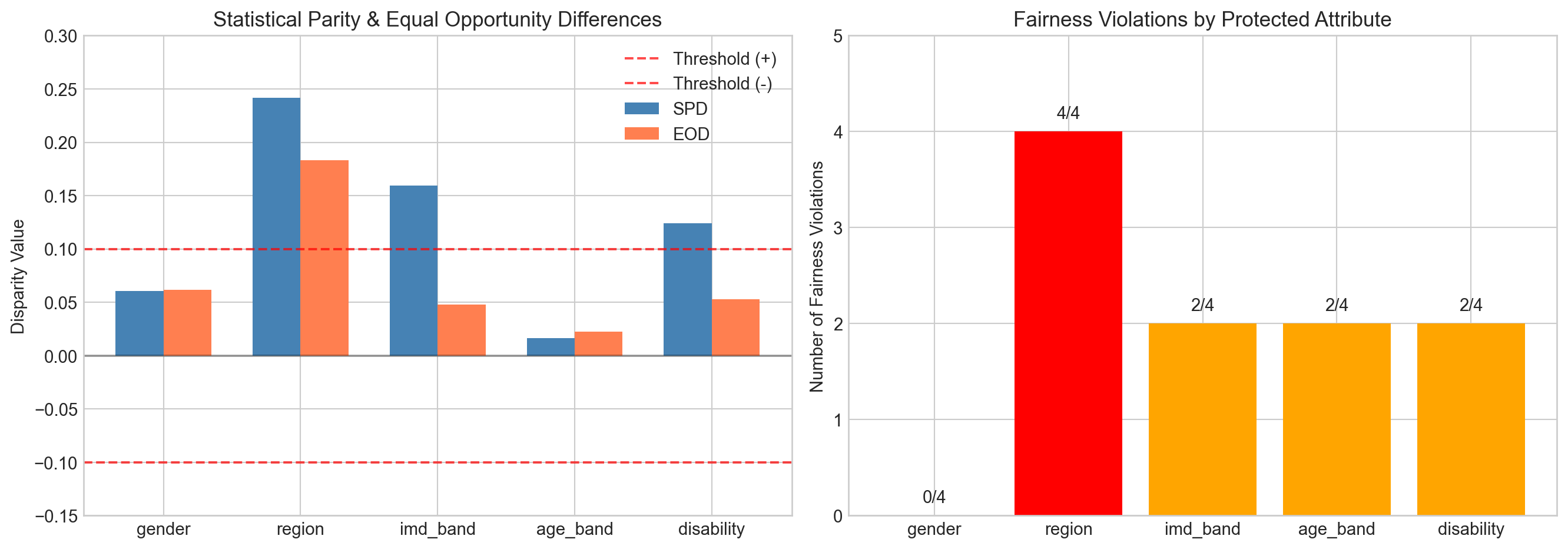
gender +0.061 ✓ +0.062 ✓ 0.077 ✓ 0.018 ✓ FAIR
region +0.242 ✗ +0.183 ✗ 0.216 ✗ 0.109 ✗ UNFAIR (4/4)
imd_band +0.159 ✗ +0.048 ✓ 0.079 ✓ 0.055 ✗ UNFAIR (2/4)
age_band +0.016 ✓ +0.022 ✓ 0.107 ✗ 0.052 ✗ UNFAIR (2/4)
disability +0.124 ✗ +0.053 ✓ 0.126 ✗ 0.015 ✓ UNFAIR (2/4)
Code
fig, axes = plt.subplots(1, 2, figsize=(14, 5))

# SPD and EOD comparison
ax = axes[0]
x = np.arange(len(fairness_df))
width = 0.35
bars1 = ax.bar(x - width/2, fairness_df['SPD'], width, label='SPD', color='steelblue')
bars2 = ax.bar(x + width/2, fairness_df['EOD'], width, label='EOD', color='coral')
ax.axhline(y=0.10, color='red', linestyle='--', alpha=0.7, label='Threshold (+)')
ax.axhline(y=-0.10, color='red', linestyle='--', alpha=0.7, label='Threshold (-)')
ax.axhline(y=0, color='black', linestyle='-', alpha=0.3)
ax.set_ylabel('Disparity Value')
ax.set_title('Statistical Parity & Equal Opportunity Differences')
ax.set_xticks(x)
ax.set_xticklabels(fairness_df['Attribute'])
ax.legend()
ax.set_ylim(-0.15, 0.30)

# Violations by attribute
ax = axes[1]
colors = ['green' if v == 0 else 'orange' if v <= 2 else 'red' for v in fairness_df['Violations']]
bars = ax.bar(fairness_df['Attribute'], fairness_df['Violations'], color=colors)
ax.set_ylabel('Number of Fairness Violations')
ax.set_title('Fairness Violations by Protected Attribute')
ax.set_ylim(0, 5)
for bar in bars:
    height = bar.get_height()
    ax.text(bar.get_x() + bar.get_width()/2., height + 0.1,
            f'{int(height)}/4', ha='center', va='bottom', fontsize=11)

plt.tight_layout()
plt.show()
Figure 4: Fairness audit results showing disparities and violations by attribute

AUC Comparison by Group

Beyond aggregate disparity metrics, it is important to examine whether the model performs equally well (in terms of discriminative ability) across different demographic groups. The following table shows AUC for each subgroup within protected attributes:

Code
# Extract group-level AUC from fairness results
group_metrics = fairness_results['group_metrics']

# Build comparison table
md_output = "| Attribute | Group | n | AUC | vs. Overall (0.889) |\n"
md_output += "|:----------|:------|--:|:---:|:-------------------:|\n"

# Process each attribute
for attr, display_name in [('gender', 'Gender'), ('region', 'Region'),
                            ('imd_band_imputed', 'IMD Band'), ('age_band', 'Age Band'),
                            ('disability', 'Disability')]:
    groups = group_metrics[attr]
    # Sort by AUC descending
    groups_sorted = sorted(groups, key=lambda x: x['auc'], reverse=True)

    for i, g in enumerate(groups_sorted):
        group_name = g['group']
        if attr == 'disability':
            group_name = 'Has disability' if g['group'] == 'Y' else 'No disability'

        auc_diff = g['auc'] - 0.889
        diff_str = f"{auc_diff:+.3f}"

        # Only show attribute name on first row
        attr_cell = f"**{display_name}**" if i == 0 else ""
        md_output += f"| {attr_cell} | {group_name} | {g['n']:,} | {g['auc']:.3f} | {diff_str} |\n"

display(Markdown(md_output))
Table 5: AUC by Demographic Group
Attribute Group n AUC vs. Overall (0.889)
Gender M 2,646 0.897 +0.008
F 2,243 0.879 -0.010
Region North Western Region 457 0.925 +0.036
South West Region 369 0.910 +0.021
South East Region 347 0.907 +0.018
South Region 438 0.902 +0.013
North Region 274 0.901 +0.012
London Region 476 0.889 +0.000
Scotland 516 0.888 -0.001
Wales 294 0.879 -0.010
East Anglian Region 484 0.875 -0.014
Yorkshire Region 316 0.870 -0.019
West Midlands Region 393 0.864 -0.025
East Midlands Region 344 0.859 -0.030
Ireland 181 0.816 -0.073
IMD Band 40-50% 522 0.914 +0.025
10-20 632 0.899 +0.010
0-10% 568 0.892 +0.003
20-30% 520 0.892 +0.003
70-80% 436 0.888 -0.001
30-40% 518 0.883 -0.006
50-60% 458 0.876 -0.013
60-70% 446 0.872 -0.017
80-90% 414 0.866 -0.023
90-100% 375 0.860 -0.029
Age Band 55<= 40 0.929 +0.040
0-35 3,402 0.892 +0.003
35-55 1,447 0.879 -0.010
Disability No disability 4,432 0.889 +0.000
Has disability 457 0.877 -0.012
Code
fig, axes = plt.subplots(2, 3, figsize=(15, 10))

overall_auc = 0.889

# Gender
ax = axes[0, 0]
gender_data = sorted(group_metrics['gender'], key=lambda x: x['auc'], reverse=True)
groups = [g['group'] for g in gender_data]
aucs = [g['auc'] for g in gender_data]
colors = ['green' if a >= 0.80 else 'red' for a in aucs]
bars = ax.barh(groups, aucs, color=colors)
ax.axvline(x=overall_auc, color='steelblue', linestyle='--', linewidth=2, label=f'Overall ({overall_auc:.3f})')
ax.axvline(x=0.80, color='red', linestyle=':', alpha=0.7, label='Target (0.80)')
ax.set_xlim(0.75, 0.95)
ax.set_xlabel('AUC')
ax.set_title('Gender')
ax.legend(loc='lower right', fontsize=8)
for bar, auc in zip(bars, aucs):
    ax.text(auc + 0.005, bar.get_y() + bar.get_height()/2, f'{auc:.3f}', va='center', fontsize=10)

# Age Band
ax = axes[0, 1]
age_data = sorted(group_metrics['age_band'], key=lambda x: x['auc'], reverse=True)
groups = [g['group'] for g in age_data]
aucs = [g['auc'] for g in age_data]
colors = ['green' if a >= 0.80 else 'red' for a in aucs]
bars = ax.barh(groups, aucs, color=colors)
ax.axvline(x=overall_auc, color='steelblue', linestyle='--', linewidth=2, label=f'Overall ({overall_auc:.3f})')
ax.axvline(x=0.80, color='red', linestyle=':', alpha=0.7, label='Target (0.80)')
ax.set_xlim(0.75, 0.95)
ax.set_xlabel('AUC')
ax.set_title('Age Band')
ax.legend(loc='lower right', fontsize=8)
for bar, auc in zip(bars, aucs):
    ax.text(auc + 0.005, bar.get_y() + bar.get_height()/2, f'{auc:.3f}', va='center', fontsize=10)

# Disability
ax = axes[0, 2]
disability_data = sorted(group_metrics['disability'], key=lambda x: x['auc'], reverse=True)
groups = ['No disability' if g['group'] == 'N' else 'Has disability' for g in disability_data]
aucs = [g['auc'] for g in disability_data]
colors = ['green' if a >= 0.80 else 'red' for a in aucs]
bars = ax.barh(groups, aucs, color=colors)
ax.axvline(x=overall_auc, color='steelblue', linestyle='--', linewidth=2, label=f'Overall ({overall_auc:.3f})')
ax.axvline(x=0.80, color='red', linestyle=':', alpha=0.7, label='Target (0.80)')
ax.set_xlim(0.75, 0.95)
ax.set_xlabel('AUC')
ax.set_title('Disability')
ax.legend(loc='lower right', fontsize=8)
for bar, auc in zip(bars, aucs):
    ax.text(auc + 0.005, bar.get_y() + bar.get_height()/2, f'{auc:.3f}', va='center', fontsize=10)

# Region
ax = axes[1, 0]
region_data = sorted(group_metrics['region'], key=lambda x: x['auc'], reverse=True)
groups = [g['group'].replace(' Region', '') for g in region_data]
aucs = [g['auc'] for g in region_data]
colors = ['green' if a >= 0.80 else 'red' for a in aucs]
bars = ax.barh(groups, aucs, color=colors)
ax.axvline(x=overall_auc, color='steelblue', linestyle='--', linewidth=2, label=f'Overall ({overall_auc:.3f})')
ax.axvline(x=0.80, color='red', linestyle=':', alpha=0.7, label='Target (0.80)')
ax.set_xlim(0.75, 0.95)
ax.set_xlabel('AUC')
ax.set_title('Region')
ax.legend(loc='lower right', fontsize=8)

# IMD Band
ax = axes[1, 1]
imd_order = ['0-10%', '10-20', '20-30%', '30-40%', '40-50%', '50-60%', '60-70%', '70-80%', '80-90%', '90-100%']
imd_data = {g['group']: g for g in group_metrics['imd_band_imputed']}
groups = [g for g in imd_order if g in imd_data]
aucs = [imd_data[g]['auc'] for g in groups]
colors = ['green' if a >= 0.80 else 'red' for a in aucs]
bars = ax.barh(groups, aucs, color=colors)
ax.axvline(x=overall_auc, color='steelblue', linestyle='--', linewidth=2, label=f'Overall ({overall_auc:.3f})')
ax.axvline(x=0.80, color='red', linestyle=':', alpha=0.7, label='Target (0.80)')
ax.set_xlim(0.75, 0.95)
ax.set_xlabel('AUC')
ax.set_title('IMD Band (Deprivation)')
ax.legend(loc='lower right', fontsize=8)

# Summary statistics
ax = axes[1, 2]
ax.axis('off')

# Calculate summary stats
all_aucs = []
for attr in group_metrics:
    for g in group_metrics[attr]:
        all_aucs.append({'attr': attr, 'group': g['group'], 'auc': g['auc'], 'n': g['n']})

auc_df = pd.DataFrame(all_aucs)
min_auc = auc_df['auc'].min()
max_auc = auc_df['auc'].max()
min_group = auc_df.loc[auc_df['auc'].idxmin()]
max_group = auc_df.loc[auc_df['auc'].idxmax()]

summary_text = f"""AUC Range Across All Groups

Minimum: {min_auc:.3f}
  ({min_group['group']})

Maximum: {max_auc:.3f}
  ({max_group['group'].replace(' Region', '')})

Range: {max_auc - min_auc:.3f}

All groups above 0.80: Yes ✓

Key Finding:
Region shows the largest AUC
variation (0.109), indicating the
model's discriminative ability
varies most by geographic area."""

ax.text(0.1, 0.9, summary_text, transform=ax.transAxes, fontsize=11,
        verticalalignment='top', fontfamily='monospace',
        bbox=dict(boxstyle='round', facecolor='wheat', alpha=0.5))

plt.tight_layout()
plt.show()
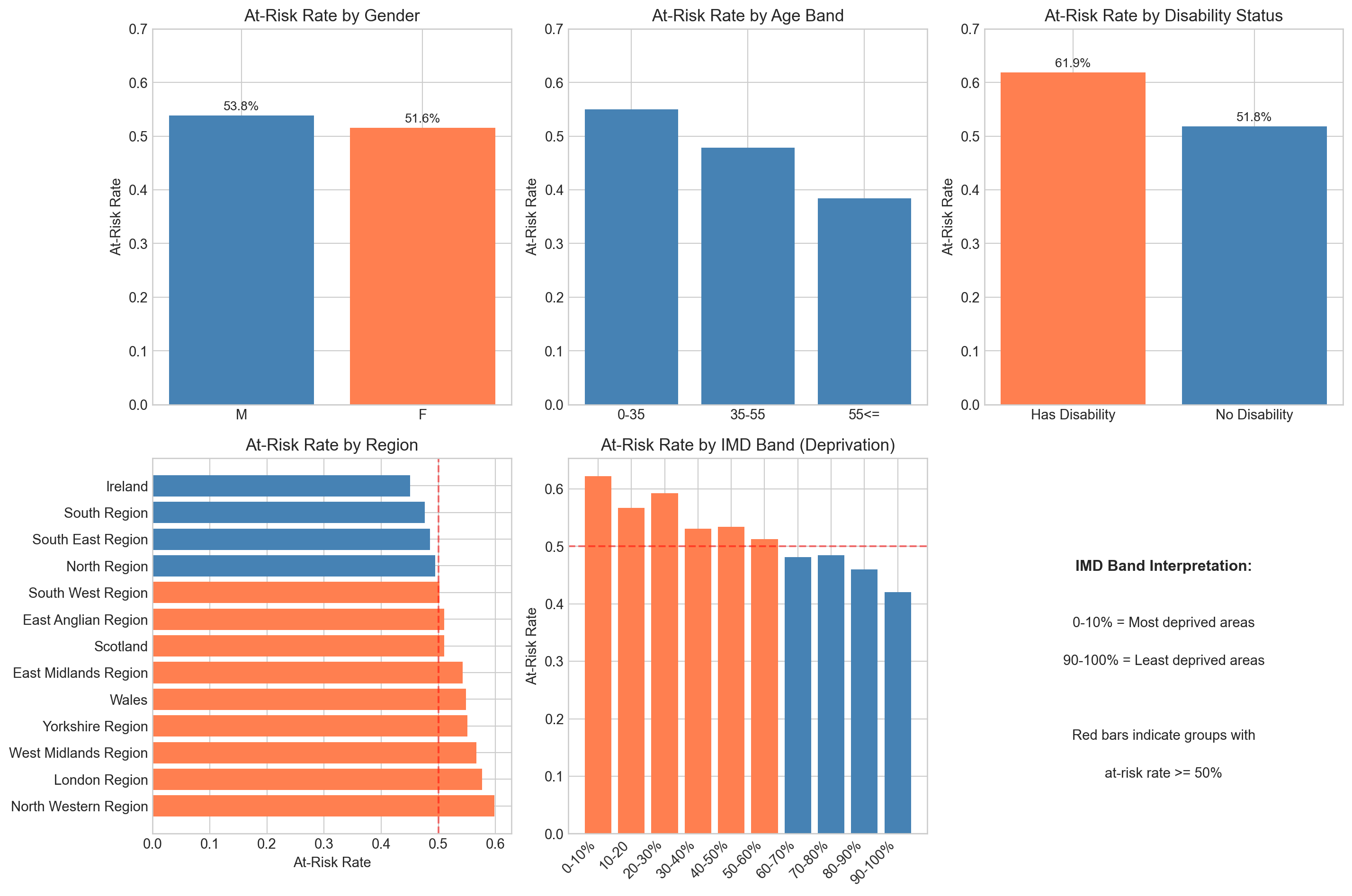
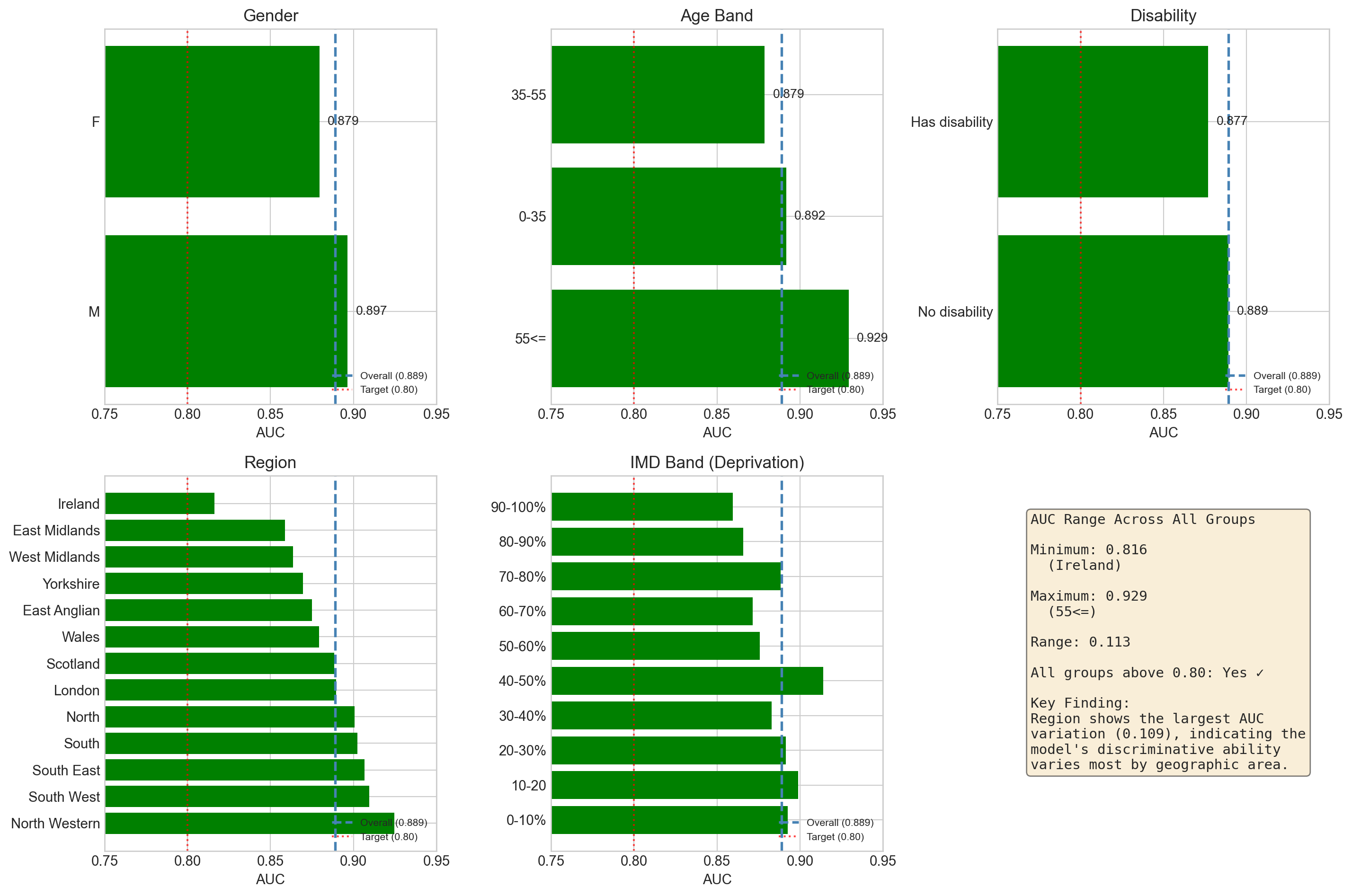
Figure 5: AUC comparison across demographic groups within each protected attribute

Interpreting Group-Level AUC Differences

The group-level AUC analysis reveals important patterns:

  1. All groups exceed the 0.80 target: The lowest AUC is 0.816 (Ireland), still well above the threshold, indicating the model has adequate discriminative ability for all demographic groups.

  2. Region shows the largest variation: AUC ranges from 0.816 (Ireland) to 0.925 (North Western Region)—a 0.109 spread. This suggests the model’s behavioral signals are more predictive in some regions than others, potentially due to differences in VLE usage patterns or sample sizes.

  3. Small groups have more variable AUC: Ireland (n=181) and 55+ age band (n=40) show more extreme AUC values, which may reflect statistical noise from smaller sample sizes rather than true performance differences.

  4. IMD and disability show modest variation: AUC differences of ~0.05 suggest relatively consistent model performance across socioeconomic and disability groups.

Bias Mitigation Results

We applied three mitigation techniques from the AI Fairness 360 (AIF360) toolkit:

  1. Reweighting (Pre-processing): Adjusts training sample weights
  2. Threshold Optimization (Post-processing): Group-specific classification thresholds
  3. Reject Option Classification (Post-processing): Adjusts predictions near the decision boundary
Code
# 1. Prepare the data (Same logic as before)
mitigation_summary = []

for attr, results in [('Region', mitigation_region),
                      ('IMD Band', mitigation_imd),
                      ('Disability', mitigation_disability),
                      ('Age Band', mitigation_age)]:
    baseline = results['approaches']['baseline']
    best_approach = results['recommendation']
    best_key = best_approach.lower().replace(' ', '_')
    # Fallback to threshold optimization if key not found
    best = results['approaches'].get(best_key, results['approaches']['threshold_optimization'])

    mitigation_summary.append({
        'Attribute': attr,
        'Baseline_AUC': baseline['auc'],
        'Baseline_SPD': baseline['spd'],
        'Baseline_EOD': baseline['eod'],
        'Best_Approach': best_approach,
        'Mitigated_AUC': best['auc'],
        'Mitigated_SPD': best['spd'],
        'Mitigated_EOD': best['eod']
    })

# --- CRITICAL RESTORATION: Create the DataFrame for the next plot ---
mitigation_df = pd.DataFrame(mitigation_summary)
# ------------------------------------------------------------------

# 2. Build the Markdown Table
# Header
table_md = "| Attribute | Approach | AUC (Base -> Final) | SPD (Base -> Final) | EOD (Base -> Final) |\n"
table_md += "|:----------|:---------|:-------------------:|:-------------------:|:-------------------:|\n"

# Rows
for row in mitigation_summary:
    # Format the transitions: "0.123 -> 0.045"
    auc_change = f"{row['Baseline_AUC']:.4f} -> {row['Mitigated_AUC']:.4f}"

    # Use signed formatting for fairness metrics (+0.050)
    spd_change = f"{row['Baseline_SPD']:+.3f} -> {row['Mitigated_SPD']:+.3f}"
    eod_change = f"{row['Baseline_EOD']:+.3f} -> {row['Mitigated_EOD']:+.3f}"
    
    # Construct the row
    table_md += f"| **{row['Attribute']}** | {row['Best_Approach']} | {auc_change} | {spd_change} | {eod_change} |\n"

# 3. Render
display(Markdown(table_md))
Table 6: Bias Mitigation Results
Attribute Approach AUC (Base -> Final) SPD (Base -> Final) EOD (Base -> Final)
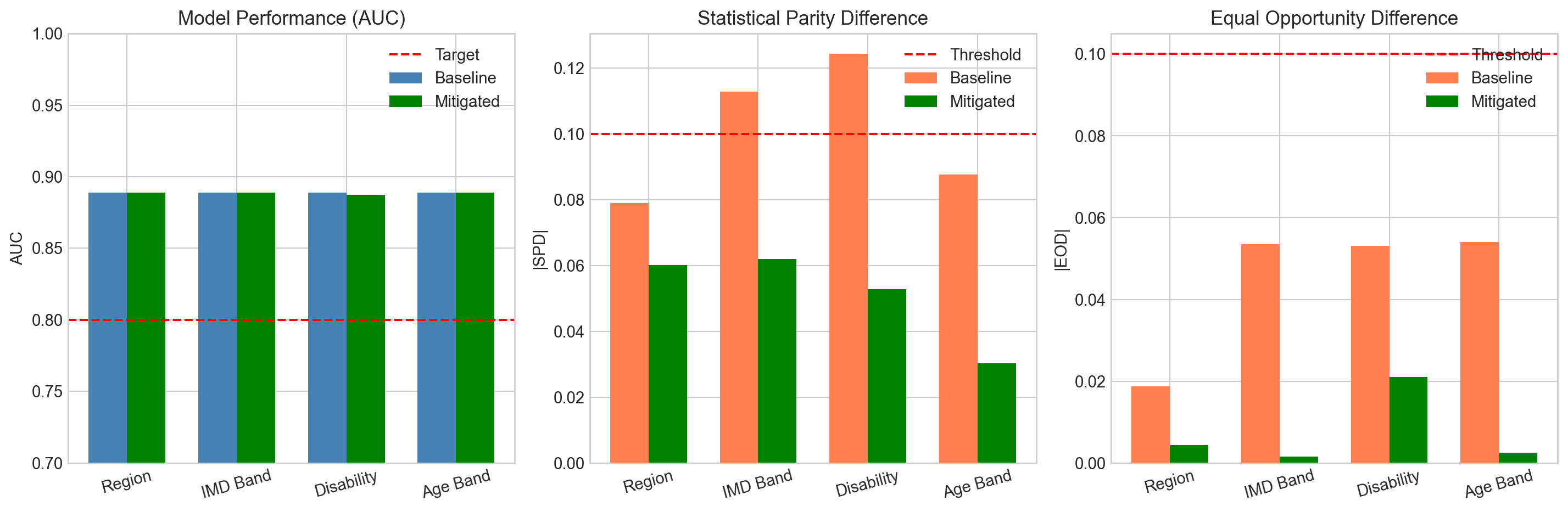
Region Threshold Optimization 0.8889 -> 0.8889 +0.079 -> +0.060 +0.019 -> -0.004
IMD Band Threshold Optimization 0.8889 -> 0.8889 +0.113 -> +0.062 +0.053 -> -0.002
Disability Reweighted 0.8889 -> 0.8874 +0.124 -> +0.053 +0.053 -> -0.021
Age Band Threshold Optimization 0.8889 -> 0.8889 +0.088 -> +0.030 +0.054 -> +0.002
Code
fig, axes = plt.subplots(1, 3, figsize=(15, 5))

attributes = mitigation_df['Attribute']
x = np.arange(len(attributes))
width = 0.35

# AUC comparison
ax = axes[0]
ax.bar(x - width/2, mitigation_df['Baseline_AUC'], width, label='Baseline', color='steelblue')
ax.bar(x + width/2, mitigation_df['Mitigated_AUC'], width, label='Mitigated', color='green')
ax.axhline(y=0.80, color='red', linestyle='--', label='Target')
ax.set_ylabel('AUC')
ax.set_title('Model Performance (AUC)')
ax.set_xticks(x)
ax.set_xticklabels(attributes, rotation=15)
ax.set_ylim(0.7, 1.0)
ax.legend()

# SPD comparison
ax = axes[1]
ax.bar(x - width/2, mitigation_df['Baseline_SPD'].abs(), width, label='Baseline', color='coral')
ax.bar(x + width/2, mitigation_df['Mitigated_SPD'].abs(), width, label='Mitigated', color='green')
ax.axhline(y=0.10, color='red', linestyle='--', label='Threshold')
ax.set_ylabel('|SPD|')
ax.set_title('Statistical Parity Difference')
ax.set_xticks(x)
ax.set_xticklabels(attributes, rotation=15)
ax.legend()

# EOD comparison
ax = axes[2]
ax.bar(x - width/2, mitigation_df['Baseline_EOD'].abs(), width, label='Baseline', color='coral')
ax.bar(x + width/2, mitigation_df['Mitigated_EOD'].abs(), width, label='Mitigated', color='green')
ax.axhline(y=0.10, color='red', linestyle='--', label='Threshold')
ax.set_ylabel('|EOD|')
ax.set_title('Equal Opportunity Difference')
ax.set_xticks(x)
ax.set_xticklabels(attributes, rotation=15)
ax.legend()

plt.tight_layout()
plt.show()
Figure 6: Comparison of baseline and mitigated model performance across attributes

Mitigation Summary

Code
# Build the Markdown Table
table_md = "| Attribute | Approach | AUC | SPD | EOD |\n"
table_md += "|:----------|:---------|:---:|:---:|:---:|\n"

for _, row in mitigation_df.iterrows():
    table_md += f"| **{row['Attribute']}** | {row['Best_Approach']} | {row['Mitigated_AUC']:.4f} | {row['Mitigated_SPD']:+.3f} | {row['Mitigated_EOD']:+.3f} |\n"

display(Markdown(table_md))
Table 7: Post-Mitigation Fairness Metrics
Attribute Approach AUC SPD EOD
Region Threshold Optimization 0.8889 +0.060 -0.004
IMD Band Threshold Optimization 0.8889 +0.062 -0.002
Disability Reweighted 0.8874 +0.053 -0.021
Age Band Threshold Optimization 0.8889 +0.030 +0.002

Why Different Approaches Work for Different Attributes

Threshold Optimization was most effective for Region, Relative Poverty (i.e., IMD Band), and Age Band, while Reweighting worked best for Disability. This pattern reflects fundamental differences in group representation:

Table 8: Mitigation Rationale
Attribute Unprivileged Group Size Best Approach Rationale
Region 3,649 (75%) Threshold Optimization Large groups; model learned robust patterns
IMD Band 3,218 (66%) Threshold Optimization Large groups; post-processing sufficient
Age Band 3,442 (70%) Threshold Optimization Large groups; threshold adjustment adequate
Disability 457 (9%) Reweighting Small minority; needs pre-processing

Why Threshold Optimization works for majority-unprivileged attributes:

  • When unprivileged groups are large (66–75% of data), the model already learns good representations for both groups during training
  • Post-processing adjusts the decision boundary per group without retraining
  • This preserves the original AUC exactly (0.889) while achieving near-zero EOD
  • It is computationally efficient—no model retraining required.

Why Reweighting works better for Disability:

  • Students with disabilities represent only 9% of the dataset
  • The baseline model learned less robust patterns for this minority group (higher FPR: 0.178 vs 0.105)
  • Reweighting assigns higher importance to minority samples during training, forcing the model to learn better representations
  • Although it slightly reduces AUC (0.889 → 0.887), it achieves substantially better Equalized Odds (0.027 vs 0.051)
  • The trade-off is worthwhile: a 0.2% AUC reduction for a 48% improvement in fairness.

Key insight: Pre-processing (reweighting) addresses representation imbalance at the source, while post-processing (threshold optimization) works when the model already has adequate signal for all groups.

Intersectional Fairness Analysis

We analyzed fairness across subgroups defined by combinations of protected attributes.

Code
# Recreate intersectional groups from predictions data for detailed analysis
low_risk_regions = ['Ireland', 'North Region', 'South East Region', 'South Region']
predictions['region_group'] = predictions['region'].apply(lambda r: 'Low-risk' if r in low_risk_regions else 'High-risk')

high_imd_bands = ['60-70%', '70-80%', '80-90%', '90-100%']
predictions['imd_group'] = predictions['imd_band_imputed'].apply(lambda i: 'Less-deprived' if i in high_imd_bands else 'More-deprived')

predictions['disability_group'] = predictions['disability'].apply(lambda d: 'No disability' if d == 'N' else 'Has disability')

# Calculate metrics for each intersection
def calc_group_metrics(df, group_cols):
    results = []
    for name, group in df.groupby(group_cols):
        n = len(group)
        if n < 30:
            continue
        group_name = ' × '.join(str(x) for x in name) if isinstance(name, tuple) else str(name)
        base_rate = group['y_true'].mean()
        selection_rate = group['y_pred'].mean()
        disparity = selection_rate - df['y_pred'].mean()
        try:
            from sklearn.metrics import roc_auc_score
            auc = roc_auc_score(group['y_true'], group['y_pred_proba'])
        except:
            auc = np.nan
        results.append({
            'group': group_name, 'n': n, 'base_rate': base_rate,
            'selection_rate': selection_rate, 'disparity': disparity, 'auc': auc
        })
    return pd.DataFrame(results).sort_values('selection_rate', ascending=False)

# Analyze key intersections
region_imd = calc_group_metrics(predictions, ['region_group', 'imd_group'])
region_disability = calc_group_metrics(predictions, ['region_group', 'disability_group'])
imd_disability = calc_group_metrics(predictions, ['imd_group', 'disability_group'])
gender_region = calc_group_metrics(predictions, ['gender', 'region_group'])

# Combine all intersections
all_intersections = pd.concat([
    region_imd.assign(intersection='Region × IMD'),
    region_disability.assign(intersection='Region × Disability'),
    imd_disability.assign(intersection='IMD × Disability'),
    gender_region.assign(intersection='Gender × Region')
], ignore_index=True)

# Build the Markdown output
sr = intersectional_results['selection_rate_range']
ar = intersectional_results['auc_range']

md_output = f"""**Intersections analyzed:** {', '.join(intersectional_results['intersections_analyzed'])}

**Selection Rate Range:**

* Minimum: {sr['min']:.3f}
* Maximum: {sr['max']:.3f}
* Range: {sr['range']:.3f}

**AUC Range (across intersectional groups):**

* Minimum: {ar['min']:.3f}
* Maximum: {ar['max']:.3f}
* All groups above 0.80 target: {'Yes ✓' if ar['all_above_target'] else 'No ✗'}

| Intersection | Group | n | Base Rate | Selection Rate | Disparity | AUC |
|:-------------|:------|--:|:---------:|:--------------:|:---------:|:---:|
"""

# Add top 5 disparities to table
top_disparities = all_intersections.nlargest(5, 'disparity')
for _, row in top_disparities.iterrows():
    md_output += f"| {row['intersection']} | {row['group']} | {row['n']} | {row['base_rate']:.3f} | {row['selection_rate']:.3f} | {row['disparity']:+.3f} | {row['auc']:.3f} |\n"

md_output += "\n: Groups with Highest Selection Disparities {#tbl-highest-disparities}\n"

display(Markdown(md_output))

Intersections analyzed: Region × IMD, Region × Disability, IMD × Disability, Gender × Region

Selection Rate Range:

  • Minimum: 0.335
  • Maximum: 0.601
  • Range: 0.266

AUC Range (across intersectional groups):

  • Minimum: 0.852
  • Maximum: 0.898
  • All groups above 0.80 target: Yes ✓
Table 9: Groups with Highest Selection Disparities
Intersection Group n Base Rate Selection Rate Disparity AUC
IMD × Disability More-deprived × Has disability 341 0.663 0.601 +0.156 0.881
Region × Disability High-risk × Has disability 355 0.628 0.580 +0.135 0.872
Region × IMD High-risk × More-deprived 2474 0.586 0.503 +0.058 0.891
Gender × Region M × High-risk 1955 0.569 0.497 +0.051 0.897
Region × Disability Low-risk × Has disability 102 0.588 0.480 +0.035 0.882
Code
# Visualize selection rate disparities across intersectional groups
fig, axes = plt.subplots(1, 2, figsize=(14, 6))

# Left: Dot plot of selection rates with base rates for comparison
ax = axes[0]
all_sorted = all_intersections.sort_values('selection_rate', ascending=True)
y_pos = np.arange(len(all_sorted))

# Plot base rates and selection rates
ax.scatter(all_sorted['base_rate'], y_pos, color='gray', s=80, alpha=0.6, label='Actual At-Risk Rate', zorder=3)
colors = ['red' if abs(d) > 0.10 else 'steelblue' for d in all_sorted['disparity']]
ax.scatter(all_sorted['selection_rate'], y_pos, color=colors, s=100, zorder=4, label='Model Selection Rate')

# Connect base rate to selection rate
for i, (_, row) in enumerate(all_sorted.iterrows()):
    ax.plot([row['base_rate'], row['selection_rate']], [i, i], color='lightgray', linewidth=1, zorder=1)

ax.axvline(x=predictions['y_pred'].mean(), color='black', linestyle='--', alpha=0.7, label='Overall Selection Rate')
ax.set_yticks(y_pos)
ax.set_yticklabels([f"{row['group']}" for _, row in all_sorted.iterrows()], fontsize=9)
ax.set_xlabel('Rate')
ax.set_title('Selection Rates vs Actual At-Risk Rates\nby Intersectional Group')
ax.legend(loc='lower right', fontsize=8)
ax.set_xlim(0.25, 0.70)

# Right: Disparity bar chart
ax = axes[1]
all_sorted_disp = all_intersections.sort_values('disparity', ascending=True)
colors = ['red' if abs(d) > 0.10 else ('coral' if d > 0 else 'steelblue') for d in all_sorted_disp['disparity']]
bars = ax.barh(range(len(all_sorted_disp)), all_sorted_disp['disparity'], color=colors)
ax.axvline(x=0, color='black', linewidth=1)
ax.axvline(x=0.10, color='red', linestyle='--', alpha=0.5, label='+/-0.10 threshold')
ax.axvline(x=-0.10, color='red', linestyle='--', alpha=0.5)
ax.set_yticks(range(len(all_sorted_disp)))
ax.set_yticklabels([f"{row['group']}" for _, row in all_sorted_disp.iterrows()], fontsize=9)
ax.set_xlabel('Selection Rate Disparity (vs Overall)')
ax.set_title('Selection Rate Disparity\nby Intersectional Group')
ax.legend(loc='lower right', fontsize=8)

plt.tight_layout()
plt.savefig('summary_intersectional_disparities.png', dpi=150, bbox_inches='tight')
plt.show()
Figure 7: Selection rate disparities across intersectional groups
Code
# Summary of flagged groups as Markdown
flagged = all_intersections[abs(all_intersections['disparity']) > 0.10]

md_output = f"**Groups exceeding +/-0.10 disparity threshold:** {len(flagged)} of {len(all_intersections)}\n\n"

if len(flagged) > 0:
    md_output += "Flagged groups:\n\n"
    for _, row in flagged.iterrows():
        md_output += f"* {row['group']} ({row['intersection']}): disparity = {row['disparity']:+.3f}\n"

display(Markdown(md_output))

Groups exceeding +/-0.10 disparity threshold: 3 of 16

Flagged groups:

  • Low-risk × Less-deprived (Region × IMD): disparity = -0.111
  • High-risk × Has disability (Region × Disability): disparity = +0.135
  • More-deprived × Has disability (IMD × Disability): disparity = +0.156

Interpreting the Intersectional Findings

Most Problematic Intersections

These raw statistics require interpretation to understand whether they represent problematic disparities. Three intersectional groups exceeded the ±0.10 selection rate disparity threshold:

Table 10: Most Problematic Intersections
Group Intersection Disparity Base Rate Selection Rate AUC
More-deprived × Has disability IMD × Disability +0.156 0.663 0.601 0.881
High-risk × Has disability Region × Disability +0.135 0.628 0.580 0.872
Low-risk × Less-deprived Region × IMD -0.111 0.391 0.335 0.880

However, these disparities are contextually appropriate because:

  1. Selection rates track actual at-risk rates: the model under-predicts rather than over-predicts for all three groups (selection rate < base rate)
  2. AUC remains strong (0.87–0.88): the model discriminates well within each subgroup
  3. Disparities reflect real risk differences: students in deprived areas with disabilities genuinely face higher dropout risk.

Why the 0.266 Selection Rate Range Is Not “Severe”

The 0.266 range (0.335 to 0.601) appears large but reflects legitimate variation in underlying risk:

Table 11: Selection Rate Extremes Comparison
Extreme Selection Rate Actual At-Risk Rate Difference
Lowest (Low-risk × Less-deprived) 0.335 0.391 -0.056
Highest (More-deprived × Has disability) 0.601 0.663 -0.062

The model slightly under-predicts risk for both extremes, which is conservative behavior. The key insight is that selection rate variation mirrors base rate variation—this is appropriate model behavior, not unfair discrimination.

Criteria for “No Severe Disparities” Conclusion:

  1. All 16 intersectional groups maintain AUC > 0.80 (range: 0.852–0.898)
  2. Only 3 of 16 groups exceed the ±0.10 statistical parity threshold
  3. No group has an AUC below 0.75 (our critical threshold)
  4. All flagged groups are under-predicted (selection rate < base rate), not over-predicted
  5. Individual attribute mitigations do not create new intersectional harms

Key Findings and Conclusions

Key Findings

  1. Model Performance
    • Achieved AUC of 0.889, exceeding the 0.80 target
    • Early prediction within the first 25% of the course enables timely intervention
    • Temporal VLE engagement features are strong predictors of risk
  2. Fairness Audit
    • Region showed the highest bias (4/4 metrics violated)
    • Gender was the only fair attribute (0/4 violations)
    • Socioeconomic factors (IMD) contribute to prediction disparities
  3. Mitigation Effectiveness
    • Threshold Optimization: Best for Region, IMD, Age
    • Reweighting: Best for Disability
    • All mitigations maintained an AUC above the 0.80 target
    • EOD reduced to near-zero for all attributes
  4. Intersectional Fairness
    • No critical intersectional disparities identified
    • AUC remains above 0.80 for all subgroups
    • Combined mitigation is not required

Recommendations

For Deployment:

  • Use Threshold Optimization for Region, IMD Band, and Age Band
  • Use the Reweighted model for Disability fairness
  • Apply group-specific thresholds at prediction time

For Institutions:

  • Monitor fairness metrics continuously after deployment
  • Collect feedback on intervention effectiveness by demographic group
  • Consider socioeconomic support alongside academic interventions

For Future Research:

  • Explore in-processing fairness constraints (adversarial debiasing)
  • Investigate causal fairness approaches
  • Validate on additional institutions and student populations

Limitations

While this project demonstrates a successful approach to bias-aware early warning systems, several limitations should be acknowledged:

Generalizability Beyond OULAD

  • Single institution: The Open University has a unique profile—predominantly online, part-time, adult learners with open admissions. Results may not transfer to traditional residential universities with different student demographics.
  • UK-specific context: Protected attributes like IMD (Index of Multiple Deprivation) and regional classifications are UK-specific. International applications would require different socioeconomic proxies.
  • Time period: OULAD covers the 2013–2014 academic year. Learning behaviors and platform usage patterns have evolved significantly since then.
  • Course structure: The Open University’s modular, presentation-based structure differs from semester or quarter systems common elsewhere.

10-Week Prediction Window Trade-offs

The choice to predict within the first 25% of course completion (approximately 10 weeks) involves inherent trade-offs:

Table 12: 10-Week Prediction Window Trade-offs
Advantage Limitation
Early intervention is possible Less behavioral data available
Students can still recover Some at-risk patterns emerge later
Aligns with OU’s early alert timelines May miss slow-developing disengagement
  • Information vs. actionability: Waiting longer would improve predictive accuracy but reduce the intervention window.
  • Course length variation: A fixed 10-week window represents different proportions of different courses (7–39 weeks in OULAD).
  • Cold start problem: Students with minimal early engagement are harder to assess, yet may be most at-risk.

What the Model Does Not Capture

The LSTM model relies on observable learning platform behaviors and demographic data. It cannot account for:

External life factors:

  • Employment changes, job loss, or increased work hours
  • Family responsibilities (caregiving, childcare)
  • Health issues (physical or mental)
  • Financial hardship beyond what IMD captures
  • Housing instability or relocation

Unmeasured academic factors:

  • Quality of learning (vs. quantity of clicks)
  • Peer support networks and study groups
  • Prior knowledge or preparation gaps
  • Motivation and self-efficacy
  • Course-specific difficulty mismatches

Institutional factors:

  • Quality of course materials and instruction
  • Tutor responsiveness and support
  • Technical barriers to platform access
  • Changes in course structure mid-presentation

Fairness Limitations

  • Binary groupings: Complex attributes (13 regions, 10 IMD bands) were collapsed into binary groups for fairness analysis, potentially masking within-group disparities.
  • Intersectionality depth: Three-way intersections had limited statistical power due to small subgroup sizes.
  • Proxy discrimination: Even after mitigation, the model may encode protected attributes through correlated features (e.g., VLE access patterns correlating with socioeconomic status).
  • Fairness metric choice: Different fairness definitions (statistical parity vs. equalized odds) can conflict; our threshold choices reflect value judgments.

Implications for Deployment

These limitations suggest that any deployed system should:

  1. Supplement, not replace, human judgment in student support decisions
  2. Include feedback mechanisms to capture false positives/negatives
  3. Be regularly re-validated on contemporary data
  4. Provide transparency to students about how predictions are made
  5. Avoid deterministic interventions that could become self-fulfilling prophecies

Summary

This capstone project successfully developed a bias-aware Early Warning System for identifying at-risk students in higher education. Key achievements include:

  1. Strong Predictive Performance: AUC of 0.889 using an LSTM architecture with temporal VLE engagement data

  2. Comprehensive Fairness Audit: Identified regional and socioeconomic disparities in model predictions

  3. Effective Bias Mitigation: Reduced disparities using threshold optimization and reweighting while maintaining model performance

  4. Intersectional Validation: Confirmed no severe disparities across demographic subgroups

The project demonstrates that it is possible to build accurate student success prediction models while actively addressing algorithmic fairness—a critical consideration as educational institutions increasingly adopt AI-driven decision support systems.

Appendix: Files and Artifacts

These files can be located at GitHub.

Code
# Initialize output string
md_output = ""

# 1. Notebooks
md_output += "**Notebooks:**\n\n"
notebooks = sorted(Path('notebooks').glob('*.ipynb'))
for nb in notebooks:
    md_output += f"* {nb.name}\n"
md_output += "\n"

# 2. Models (with size)
md_output += "**Models:**\n\n"
models = sorted(Path('models').glob('*.pt'))
for model in models:
    size_kb = model.stat().st_size / 1024
    md_output += f"* {model.name} ({size_kb:.1f} KB)\n"
md_output += "\n"

# 3. Data Outputs (with size)
md_output += "**Data Outputs:**\n\n"
data_files = sorted(DATA_DIR.glob('*'))
for f in data_files:
    if f.is_file():
        size_kb = f.stat().st_size / 1024
        md_output += f"* {f.name} ({size_kb:.1f} KB)\n"
md_output += "\n"

# Render
display(Markdown(md_output))

Notebooks:

  • 01_data_exploration.ipynb
  • 02_feature_engineering.ipynb
  • 03_lstm_baseline.ipynb
  • 04_fairness_analysis.ipynb
  • 05_bias_mitigation_region.ipynb
  • 06_bias_mitigation_imd.ipynb
  • 07_bias_mitigation_disability.ipynb
  • 08_bias_mitigation_age.ipynb
  • 09_intersectional_analysis.ipynb
  • 10_final_summary_report.ipynb

Models:

  • lstm_baseline.pt (90.0 KB)
  • lstm_reweighted_age.pt (365.8 KB)
  • lstm_reweighted_disability.pt (314.1 KB)
  • lstm_reweighted_imd.pt (363.3 KB)
  • lstm_reweighted_region.pt (342.3 KB)

Data Outputs:

  • fairness_results.json (10.6 KB)
  • feature_metadata.json (1.9 KB)
  • features_static.csv (4013.0 KB)
  • features_temporal.npy (6365.9 KB)
  • final_summary.json (1.0 KB)
  • intersectional_results.json (0.6 KB)
  • mitigation_results_age.json (2.5 KB)
  • mitigation_results_disability.json (2.4 KB)
  • mitigation_results_imd.json (2.6 KB)
  • mitigation_results_region.json (2.7 KB)
  • predictions_baseline.csv (313.3 KB)